

Table of Contents
The Pyramid Framework: Metrics, KPIs and OKRs
- 5 min read
- Authored & Reviewed by: CLFI Team
The Pyramid Framework explains how organisations move from data to decisions by structuring measurement into three distinct layers: metrics, key performance indicators (KPIs), and objectives and key results (OKRs). Each layer plays a different role, beginning with raw operational data and progressing toward the strategic goals that guide executive action.
This article defines each layer in detail, explains how they relate to each other, and illustrates how the Pyramid Framework supports executive reporting, operational dashboards, and cross-functional alignment.
Table of Contents
Programme Content Overview
The Executive Certificate in Corporate Finance, Valuation & Governance delivers a full business-school-standard curriculum through flexible, self-paced modules. It covers five integrated courses — Corporate Finance, Business Valuation, Corporate Governance, Private Equity, and Mergers & Acquisitions — each contributing a defined share of the overall learning experience, combining academic depth with practical application.

Chart: Percentage weighting of each core course within the CLFI Executive Certificate curriculum.
Capital Is a Resource. Allocation Is a Strategy.
Learn more through the Executive Certificate in Corporate Finance, Valuation & Governance – a structured programme integrating governance, finance, valuation, and strategy.
Pyramid Overview
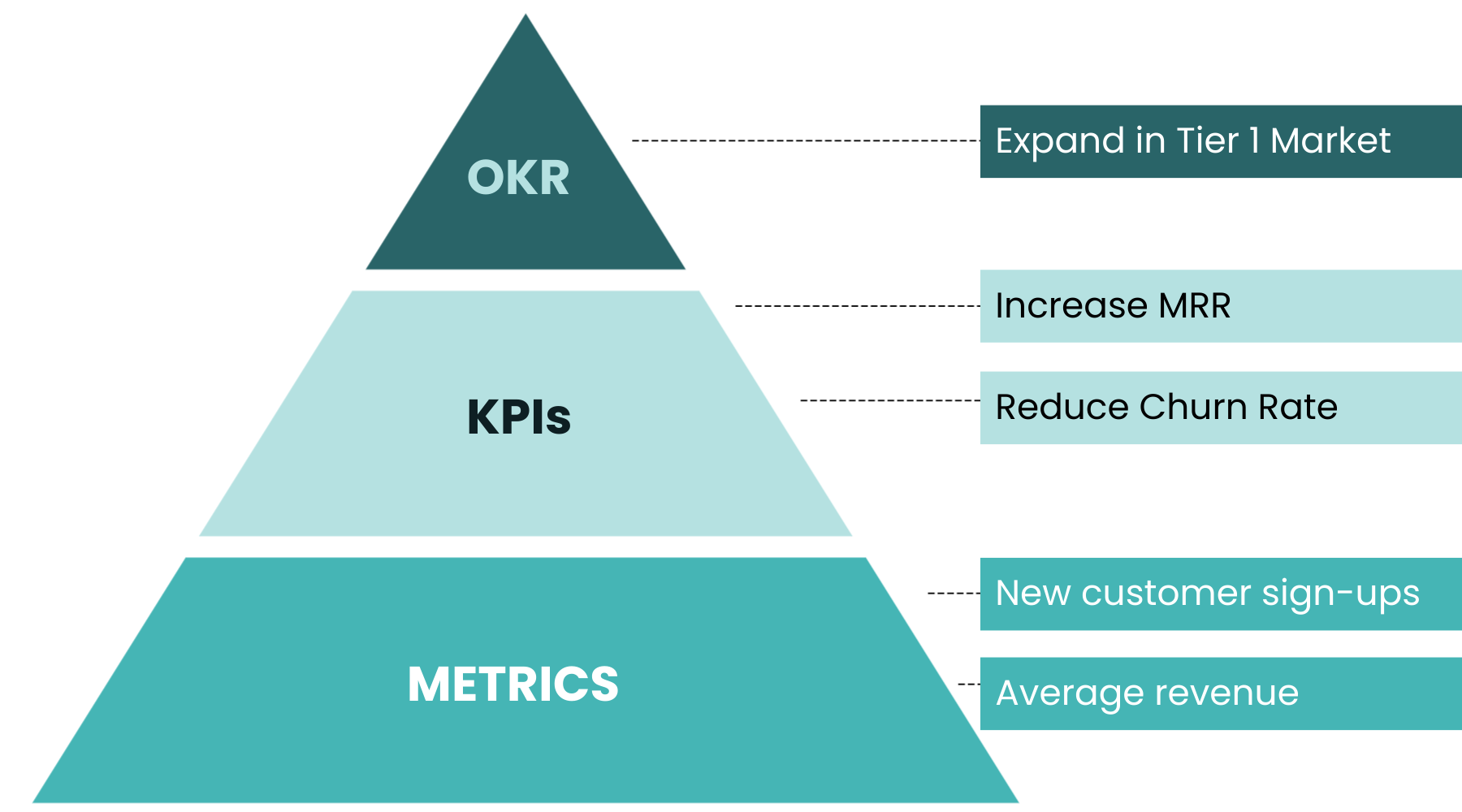
The Pyramid Framework separates business performance measurement into three levels of focus: metrics, key performance indicators (KPIs), and objectives and key results (OKRs). These are not alternative terms for the same concept. Each layer plays a different role in how data is collected, interpreted, and communicated across teams.
At the base of the pyramid, organisations generate large volumes of raw data. A small subset of that data becomes reported metrics. Fewer still are elevated into KPIs, which inform dashboards and formal reporting. At the top, company-wide goals are translated into OKRs, which direct strategic priorities and stakeholder alignment.
Definition:
Pyramid Framework
A layered model that organises business measurement into three levels: raw metrics at the base, KPIs at the operational level, and strategic OKRs at the top. It helps teams clarify which data to track, elevate, and act on.
Layer 1: Metrics
Metrics are quantitative values derived from operational data. They describe activity or behaviour, but are not necessarily indicators of performance. In most organisations, hundreds of metrics are available at any time.
| Department | Example Metrics |
|---|---|
| Marketing | Website visits, email open rate, click-through rate, ad impressions |
| Finance | Daily transaction volume, days payable outstanding, expense-to-revenue ratio |
| Operations | Average fulfilment time, return rate, units processed per hour |
| Product | Feature adoption rate, session duration, error reports per release |
Not all metrics are equally useful. Some may provide limited insight into performance, even if they are easy to track.
In practice, these operational metrics often reside in platform-specific dashboards — such as CMS, finance ERP systems, or logistics platforms — where they are tracked in isolation. While modern software makes such metrics readily accessible, they are typically fragmented across departments and tools. Moving beyond surface-level monitoring requires connecting these siloed data sets through a centralised analysis environment. This is where the role of the data analyst becomes critical: not simply accessing metrics, but integrating them to support comparative analysis, business visibility, and strategic interpretation.
Layer 2: Key Performance Indicators (KPIs)
Key performance indicators are a filtered subset of metrics that an organisation chooses to monitor formally in order to assess progress. Unlike raw metrics, KPIs are selected because they offer relevant insight into whether a team, department, or company is performing well in relation to its objectives.
Most teams track no more than five to ten KPIs. These are typically visible in dashboards and are reviewed in regular performance meetings. In a SaaS business, a product or growth team might define its KPIs around user acquisition, engagement, and monetisation. For example, they may select monthly recurring revenue (MRR), user activation rate, and trial-to-paid conversion rate as their core indicators.
Choosing the Right KPIs: Influence and Relevance
Not all measurable figures qualify as key performance indicators. Two primary criteria determine whether a metric should be elevated to KPI status:
Metrics that are easy to track but not actionable or meaningful may remain at the base of the pyramid. Those that reflect clear progress toward a team's objective, and can be shifted through practical interventions, are more suitable as KPIs.
- Number of product logins
- Average session length
- Email open rate
- Dashboard views
- Time spent on help articles
- Monthly recurring revenue (MRR)
- Trial-to-paid conversion rate
- User activation rate
- Customer acquisition cost (CAC)
- Churn rate
Layer 3: Objectives and Key Results (OKRs)
Objectives and Key Results (OKRs) form the highest layer in the metrics pyramid. While KPIs track operational performance, OKRs are designed to define and drive strategic change. They represent what the organisation aims to achieve over a defined period (e.g. quarterly, annually) and how progress will be measured.
OKRs are typically formulated by executive leadership and communicated across business units to align teams. They function as directional signals that inform decisions, resource allocation, and cross-functional priorities.
How an OKR Is Structured
For example, in a SaaS company, the objective might be "Accelerate customer growth in EMEA." The associated key results could include:
- Achieve 30% growth in MRR from EMEA
- Onboard 5 new enterprise clients
- Reduce churn in the region by 10%
How OKRs Differ from KPIs
While OKRs and KPIs are both based on quantitative data, they differ in scope and purpose. KPIs monitor performance within an established domain. They are reviewed regularly and typically remain stable over time. OKRs, by contrast, are temporary and goal-oriented. They help teams stretch toward future improvements and often reset each quarter.
- Ongoing performance indicator
- Typically remains stable over time
- Used for reporting and dashboards
- Owned at team or function level
- Time-bound strategic goal
- Changes quarter to quarter
- Used for directional alignment
- Driven by executive priorities
Functional Consistency Across the Organisation
While data platforms, terminology, and reporting tools differ across organisations, the logic of the Pyramid Framework remains consistent across business functions. Whether applied in finance, marketing, operations, or product management, the same progression applies: a wide pool of available metrics is narrowed into a focused set of KPIs, which are then aligned with broader organisational OKRs.
This consistency makes the framework transferable across sectors and roles. A professional who understands how metrics and KPIs are structured in one context, such as churn analysis within a SaaS finance team, can apply the same principles in a manufacturing operations environment or within a public-sector digital programme. The subject matter changes, but the underlying structure remains stable.
Practical Use in Reporting and Communication
Applying this layered approach improves how performance is communicated, both internally and externally. When metrics are presented without context, they often remain tactical and disconnected from decision-making. By contrast, professionals who explicitly link metrics to KPIs, and KPIs to OKRs, demonstrate a clearer understanding of how operational performance supports strategic intent.
For example, rather than stating, “Customer support resolution time decreased by 12 percent,” a more effective framing would be, “One of our core KPIs, customer support resolution time, improved by 12 percent, directly supporting the quarterly OKR of improving customer satisfaction in Tier 1 markets.” This connects operational change to a strategic objective and clarifies why the result matters.
In board discussions and business reviews, this way of structuring information signals clarity, alignment, and decision-making maturity.
In practice, the Pyramid Framework enables teams and leaders to clarify what data is being monitored, which results matter most, and how performance links to broader objectives. By using this layered approach, reporting becomes more structured, conversations become more strategic, and decisions are better aligned with organisational priorities.
Learn more in the Executive Certificate in Corporate Finance, Valuation & Governance.
Frequently Asked Questions
What is the difference between metrics, KPIs, and OKRs?
Metrics are raw measurements that describe activity or behaviour. KPIs are a selected subset of metrics used to assess performance against an objective. OKRs sit above both and define strategic direction by setting time-bound objectives and measurable outcomes. In practice, metrics feed KPIs, and KPIs inform OKRs.
What is the difference between a KPI and an OKR?
KPIs are ongoing indicators used to monitor performance over time, such as revenue growth or churn rate. OKRs are temporary and goal-oriented, designed to drive strategic change within a defined period. KPIs tend to remain stable, while OKRs evolve as priorities change.
Are OKRs better than KPIs?
OKRs and KPIs serve different but complementary roles. KPIs provide visibility into current performance, while OKRs focus attention on where improvement or change is required. Organisations typically use both rather than choosing one over the other.
What is the difference between OKRs and SMART goals?
SMART goals describe criteria for writing clear and measurable objectives. OKRs are a broader framework for aligning objectives across teams through shared priorities and key results. In practice, SMART principles are often applied when drafting OKRs.
Are initiatives the same as OKRs?
No. OKRs define what an organisation aims to achieve and how success will be measured. Initiatives describe the actions taken to influence those outcomes. Initiatives sit below OKRs and may change as teams learn what drives results.