To become a Finance Director, you need a chartered accountancy qualification or equivalent professional credential, at least ten years of progressive finance experience spanning control, commercial, and strategic roles, and the ability to translate financial data into decisions that shape business direction. The Finance Director role sits at the intersection of technical mastery and leadership: you own the financial plan, advise the CEO and board, and direct a function that touches every part of the organisation. This guide covers the specific skills, qualifications, timeline, and career steps that lead to Finance Director appointments in the UK, grounded in the competencies that hiring committees and boards actually assess.
What a Finance Director Actually Does
A Finance Director sets direction for the finance function while acting as a partner to the CEO and operating leaders. The task is to turn operational reality into a financial plan that is credible, fundable, and aligned with strategy. This involves ownership of forecasting quality, capital allocation, working capital discipline, and the governance processes that protect the organisation.
Financial planning and analysis sits at the core of the role. The Finance Director owns the budget cycle, rolling forecasts, and the variance analysis that tells the business whether it is on track. This is not spreadsheet production; it is the translation of commercial assumptions into financial outcomes, and the communication of those outcomes to people who make resource decisions.
Capital allocation is where the role moves beyond reporting into strategy. The Finance Director evaluates investment proposals, prioritises capital expenditure, assesses acquisition opportunities, and decides how to fund growth. These decisions require fluency in discounted cash flow analysis, return metrics, and risk assessment, applied under real time pressure and board scrutiny.
Governance and compliance form the third pillar. The Finance Director ensures the integrity of financial reporting, manages the external audit relationship, maintains internal controls, and advises the board on risk. In regulated sectors, this extends to statutory compliance, tax strategy, and treasury policy. The Finance Director is often the person who signs off the accounts alongside the CEO, which makes accuracy and judgement inseparable from the role.
Communication ties everything together. The Finance Director must explain assumptions, risks, and trade-offs in language that guides action across sales, product, and operations. The ability to present a clear financial narrative to non-finance stakeholders, and to challenge assumptions constructively in board and leadership meetings, is what distinguishes a Finance Director from a senior accountant.
The Career Timeline
The path to Finance Director typically takes 10 to 15 years of progressive experience. Careers rarely follow a straight line, but most Finance Directors pass through recognisable stages. The timeline below reflects typical UK progression, though candidates who rotate across control, commercial, and strategic roles often reach Director level faster than those who stay in a single specialism.
Year 0-3 · Age 21-25
Trainee / Qualified Accountant
Training contract at a practice firm or in industry. Studying for ACA, ACCA, or CIMA while building foundations in financial reporting, audit, tax, and management accounting. The priority is completing your qualification and developing technical accuracy under supervision.
Salary: £28,000 - £45,000
Year 3-6 · Age 25-28
Finance Manager / FP&A Lead
First management responsibility. Owning budgets, forecasts, and business partnering with operational teams. Building fluency in driver-based forecasting, variance analysis, and month-end reporting. This is where you start shaping decisions rather than just producing numbers.
Salary: £45,000 - £65,000
Year 6-10 · Age 28-33
Financial Controller / Head of Finance
Full ownership of financial reporting, internal controls, and audit relationships. Managing a finance team and leading the month-end and year-end close process. Exposure to treasury, tax planning, and board reporting. The critical transition point: you stop producing analysis for others and start directing the financial agenda.
Salary: £65,000 - £95,000
Year 10-15 · Age 33-38
Finance Director
Leading the finance function, advising the CEO and board, owning the financial plan, directing capital allocation, and managing investor or lender relationships. Full accountability for financial strategy, governance, and team performance. For a detailed breakdown of the skills and CV positioning that determine who gets appointed, read the CLFI guide on
Finance Director CV skills employers look for.
Salary: £85,000 - £180,000+
Year 15+ · Age 38+
Group FD / CFO
Group-wide accountability for capital markets communication, enterprise risk, and board relationships. Leading multi-entity financial operations, investor dialogue, and strategic M&A. Compensation is heavily performance-linked with significant bonus structures. For the full CFO qualification and career pathway, see the CLFI guide on
CFO qualifications in the UK.
Salary: £130,000 - £300,000+
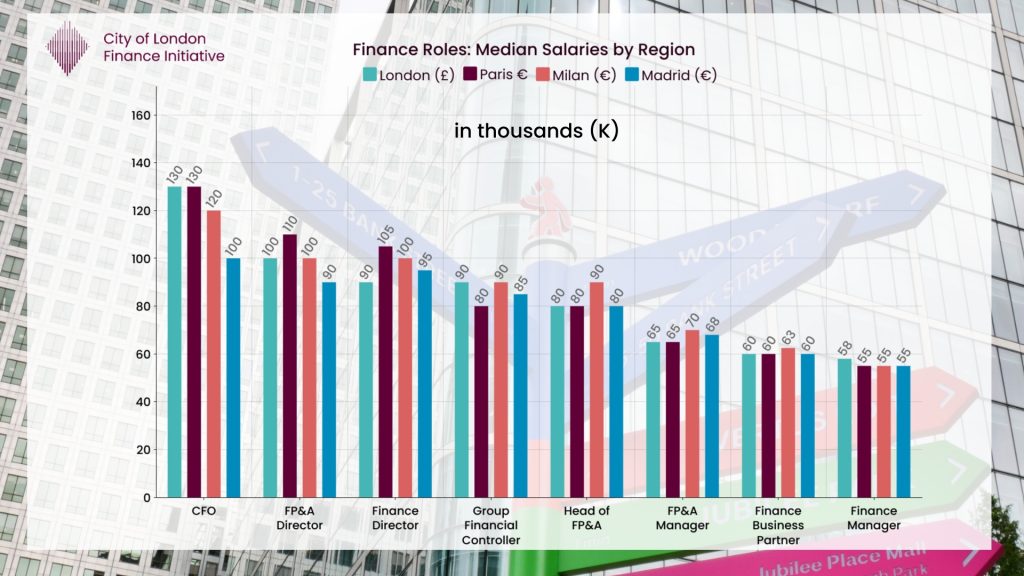
These timelines vary by sector and company size. Finance Directors in PE-backed businesses are often appointed earlier (age 30-34) because the investor expects a hands-on finance leader who can operate with limited support. In large corporates and listed groups, the timeline tends to be longer because the progression through divisional and group roles is more structured. For detailed compensation benchmarks across European finance centres, see the CLFI analysis of finance salaries in London, Paris, Milan, and Madrid.
Skills That Get You Appointed
Search committees and boards assessing Finance Director candidates look for a specific combination of technical and strategic competencies. These are the skills that separate candidates who are technically qualified from those who are ready to lead.
01
Financial Planning and Analysis
Multi-year forecasting, scenario modelling, and driver-based planning are the foundation. Finance Directors build and own the financial plan, present it to the board, and update it as conditions change. The skill is not in building the model but in knowing which assumptions matter, how sensitive the output is to each one, and how to communicate the implications clearly to non-finance stakeholders.
02
Capital Allocation and Investment Appraisal
Evaluating where to deploy capital is one of the highest-value activities a Finance Director performs. This requires fluency in NPV, IRR, payback period, and sensitivity analysis, applied not as academic exercises but as tools for prioritising competing investment proposals. The Finance Director must balance growth ambitions with cash discipline and articulate the trade-offs to the CEO and board.
Whether the context is a potential acquisition, a fundraising round, a shareholder dispute, or strategic planning, the Finance Director must be able to value a business or business unit. This means understanding
DCF valuation, comparable company analysis, and precedent transaction benchmarks. Valuation fluency allows a Finance Director to negotiate confidently and to articulate value creation to investors, lenders, and the board.
04
Treasury and Cash Management
Cash is the constraint that determines whether strategy is executable. Finance Directors manage working capital cycles, banking relationships, debt covenants, and liquidity forecasting. In PE-backed or high-growth environments, treasury skills are particularly critical because the Finance Director often manages covenant compliance and investor reporting directly. Understanding how to structure and negotiate financing facilities is a practical skill that boards value highly.
05
Corporate Governance and Risk
Boards expect Finance Directors to understand oversight frameworks, director duties, and committee structures. Familiarity with audit, risk, and remuneration principles ensures that financial leadership also safeguards transparency, ethics, and accountability. In regulated sectors, governance extends to statutory compliance, regulatory reporting, and internal control design. These are not abstract concepts; they are the mechanisms that protect the organisation and the Finance Director's own professional standing.
Experience in mergers and acquisitions brings together finance, valuation, and governance into a single decision cycle. Leading due diligence, assessing synergies, and overseeing post-deal integration broaden a Finance Director's perspective on growth, control, and culture. In mid-market businesses, the Finance Director is often the most senior financial professional on a transaction, which makes M&A capability a direct route to board credibility. For a detailed guide on M&A skills and career paths, see the CLFI guide on
how to get into M&A advisory.
Leadership and Soft Skills
Technical competence qualifies you for the role. Leadership skills determine whether you get appointed and succeed in it. Boards and CEOs consistently cite the following capabilities as the difference between a strong Financial Controller and a Finance Director who leads effectively.
Board communication. The Finance Director presents to the board regularly and must convey complex financial information with clarity and confidence. This means distilling a 50-page management accounts pack into a 10-minute narrative that highlights risks, opportunities, and the decisions that need to be made. The ability to answer challenging questions from non-executive directors without becoming defensive or overly technical is a skill that develops with practice and exposure.
Team leadership and development. A Finance Director manages a team that may range from two people in an SME to fifty or more in a large corporate. Building capability within the team, delegating effectively, and creating a culture of accuracy and accountability are ongoing responsibilities. The best Finance Directors develop their successors and build a function that operates reliably even when they are focused on strategic priorities.
Stakeholder influence. The Finance Director works across every function: operations, sales, HR, IT. The role requires the ability to challenge assumptions constructively, say no to initiatives that do not meet investment criteria, and build trust with leaders who may not have a financial background. Influence without authority, particularly with peers on the leadership team, is a defining skill.
Commercial awareness. Finance Directors who understand the commercial model, customer economics, pricing dynamics, and competitive positioning are significantly more effective than those who focus only on financial reporting. The shift from "what happened" to "what should we do" requires commercial fluency that goes beyond the numbers.
Resilience under pressure. Year-end close, audit negotiations, covenant breaches, cash flow crises, board disputes: the Finance Director role involves sustained periods of pressure where judgement and composure are essential. Candidates who demonstrate that they have navigated difficult situations, made tough calls, and maintained performance under stress are the ones who earn the trust of CEOs and boards.
Qualifications That Matter
In the UK, the majority of Finance Directors hold a chartered accountancy qualification. There is no single credential that guarantees appointment, but certain qualifications provide stronger foundations depending on the sector and career path. The table below maps the most relevant credentials to Finance Director career contexts.
| Qualification |
Issuing Body |
Finance Director Relevance |
| ACA (ICAEW) |
ICAEW |
The most common qualification among UK Finance Directors. ACA training develops financial reporting, audit, and assurance skills that build credibility with boards, auditors, and lenders. The qualification requires 450 days of practical experience and 15 exam modules. Approximately 55% of UK Finance Directors hold ACA. |
| ACCA |
ACCA |
Globally recognised, with 13 exams, a mandatory Ethics and Professional Skills Module, and post-qualification experience requirements. Particularly valuable for Finance Directors in businesses with international operations or those who trained outside the Big Four. Around 30% of UK Finance Directors hold ACCA. |
| CIMA |
CIMA / AICPA |
The management accounting route, focused on performance management, decision support, and business partnering. CIMA-qualified Finance Directors are more common in manufacturing, FMCG, and operational businesses where cost control and commercial finance are central to the role. |
| CFA |
CFA Institute |
Signals depth in valuation, investment analysis, and capital markets. Less common for Finance Directors than chartered accountancy qualifications, but increasingly valued in roles with treasury, M&A, or investor relations responsibilities. Requires a bachelor's degree and four years of professional experience. |
| Strategic Finance Leadership Programme |
City of London Finance Initiative |
An executive pathway covering corporate finance, valuation, private equity, and M&A for professionals who already hold a chartered qualification and need to bridge from operational finance to board-level strategic fluency. Designed for the specific transition from Financial Controller or Head of Finance to Finance Director. |
| MBA |
Various business schools |
Broadens business knowledge beyond finance into strategy, operations, and leadership. Not required for most Finance Director roles, but valued in larger corporates and international businesses. Most effective when combined with a chartered qualification rather than used as a substitute for one. |
For candidates already in senior finance roles who need to accelerate their readiness for a Finance Director appointment, the most effective approach is to combine a chartered foundation with targeted executive education in the specific areas that boards assess: corporate finance, valuation, governance, and M&A. For the full breakdown of the specific transition from Financial Controller to Finance Director, read the CLFI guide on how to move from Financial Controller to Finance Director.