

Table of Contents
AI in Finance: When Knowledge Is Automated, What Creates Value?
- 5 min read
- Authored & Reviewed by: CLFI Team
What began as a generative text interface (the famous ChatGPT) has evolved into a system capable of executing substantial portions of professional knowledge work through the so called ai agents. Artificial intelligence now produces financial models, forecasts, summaries, and analytical outputs with speed and consistency that would previously have required teams of trained analysts. Across global policy forums in Riyadh and at the World Economic Forum in Davos, executive discussions increasingly focus on integration, scale, and deployment. The conversation has shifted from experimentation to structural adoption, reflecting a broader reorganisation of how analytical work is performed inside firms.
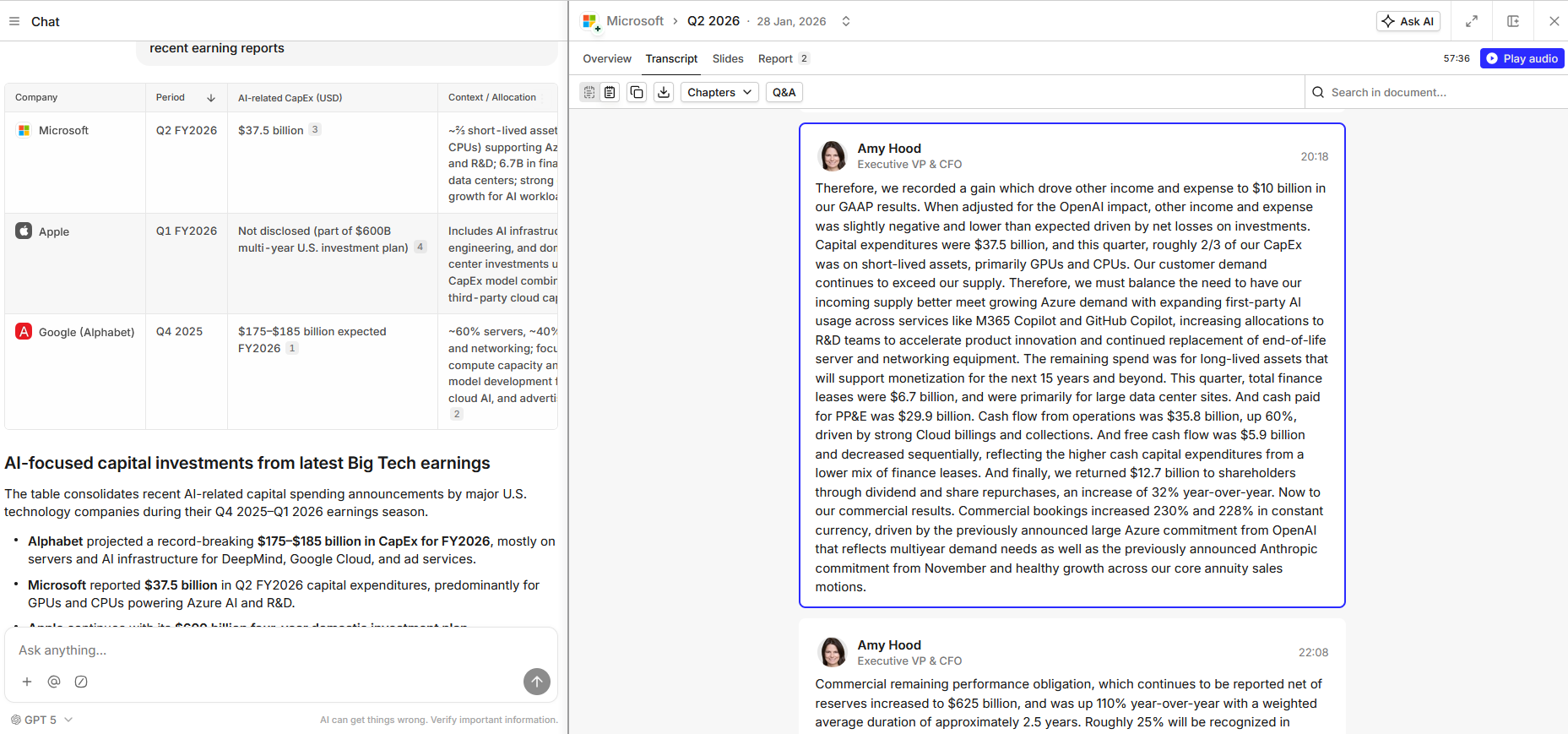
Recent earnings calls among large technology companies reinforce this direction. Capital expenditure on AI infrastructure has accelerated sharply, presented as a long-term investment in operating capability rather than a peripheral innovation initiative. Professional services firms have followed a similar path, embedding AI agents directly into delivery workflows and treating them as part of effective workforce capacity. The consequence is straightforward. The technical production of knowledge is becoming widely accessible. The responsibility for interpreting and defending decisions derived from that knowledge remains firmly human.
Big Tech AI Capital Expenditure: FY2026 Projections
-
Alphabet
Projected a record-breaking $175–$185 billion in CapEx for FY2026, mostly on servers and AI infrastructure for DeepMind, Google Cloud, and ad services.
-
Microsoft
Reported $37.5 billion in Q2 FY2026 capital expenditures, predominantly for GPUs and CPUs powering Azure AI and R&D.
-
Amazon
Plans to invest roughly $200 billion in 2026, largely in AWS to scale AI capacity, including Trainium and Graviton chip deployments and massive AI data centers.
-
Meta Platforms
Outlined $115–$135 billion of 2026 capital spending to expand infrastructure supporting Meta Superintelligence Labs, data centers, and silicon projects.
-
Oracle
Increased expected CapEx by ~$15 billion for FY2026, accelerating AI-driven Oracle Cloud Infrastructure buildouts with over 96,000 NVIDIA GB200 GPUs in place.
-
NVIDIA
Highlighted global partnerships exceeding 5 million GPU deployments, including 10 GW AI data center collaborations with OpenAI and peers such as Meta, Microsoft, and Oracle.
Editorial Note
The summary above was elaborated using an AI tool through a single prompt. Previously, our faculty and research team would have reviewed individual SEC filings, extracted relevant disclosures, interpreted the data, and consolidated the findings manually. The automated draft was produced in 28 seconds, followed by approximately two additional minutes to verify each statement against the relevant earnings transcript or Form 8-K filing.
From tools to labour capacity
Organisations are moving beyond using artificial intelligence as a productivity aid and are embedding it directly into operating structures. The distinction is important. A productivity tool enhances individual output, a labour substitute changes how work is distributed across the organisation. In several professional services firms this transition is already visible. McKinsey, for example, has disclosed that it operates with approximately 60,000 workers globally, of which around 25,000 are AI agents working alongside roughly 40,000 human employees, and has set an internal objective that each professional will be supported by at least one agent as part of standard delivery. In practical terms, AI is being treated as deployable capacity.
Knowledge-based professions have historically derived economic value from the scarcity of expertise and structured analytical capability. When financial modelling, forecasting, and structured reporting can be generated rapidly under defined assumptions, the source of differentiation shifts. The organisation still operates in an environment where future outcomes are uncertain, where money must be invested before results are known, and where incorrect decisions can damage financial performance as well as credibility with investors, employees, and customers. What changes is where human effort is required. As automated systems assume responsibility for constructing analytical outputs, the human contribution shifts toward interpreting those outputs in context, examining the assumptions that support them, and determining whether the conclusions presented are sufficiently robust to justify committing capital or altering strategic direction.
Definition:
Knowledge execution
The structured production of analytical outputs, such as financial models, forecasts, reports, or valuations, based on defined rules, assumptions, and data inputs. Knowledge execution differs from judgement because it generates technically consistent results without assuming responsibility for the consequences of decisions taken on the basis of those results.
Previously on CLFI Insight
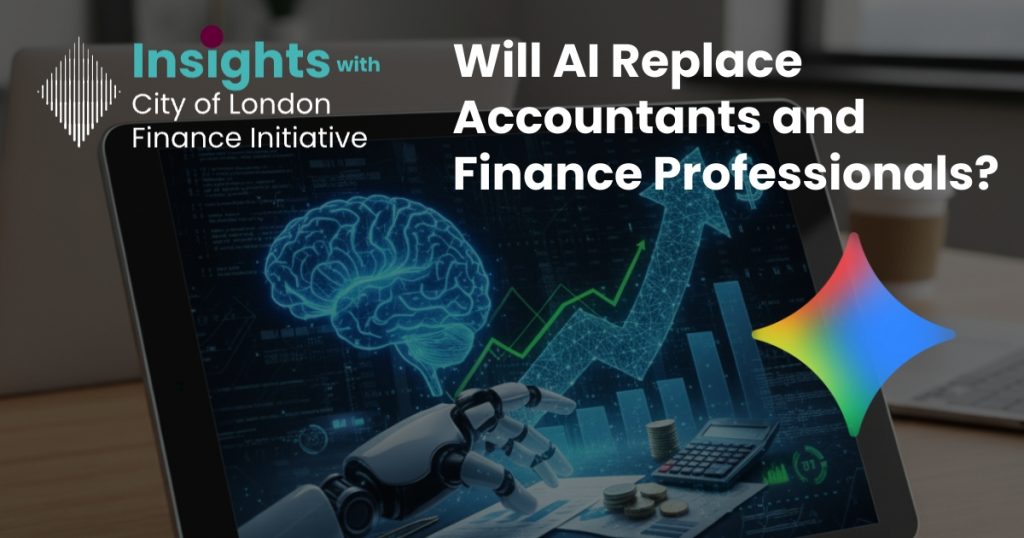
Will AI Replace Accountants and Finance Professionals? The Real Threat, and the Real Opportunity
Source: CLFI Insight, October 29, 2025
In October 2025, CLFI examined a shift that was already visible inside AI hiring markets. Firms such as Mercor, fresh from a $350 million funding round that valued the company at $10 billion, began posting roles for financial analysts, corporate finance specialists, and junior investment bankers. These were not traditional roles inside banks or operating companies. They were short-term contracts designed to train artificial intelligence systems in accounting logic, valuation techniques, and transaction analysis.
Micro1, backed by $35 million in funding, followed a similar path by recruiting finance professionals to label, review, and correct analytical outputs so AI systems could internalise structured financial reasoning. Reports also indicated that OpenAI’s internal project Mercury engaged former investment bankers at rates of up to $150 per hour to construct valuation scenarios and refine transaction models within training pipelines. In effect, experienced finance talent was being redeployed to transfer its judgement into machine systems.
The pattern was clear. Finance professionals were not being displaced immediately, they were being used to accelerate the automation of routine modelling and analytical tasks. The strategic question, explored further in this article, is what remains once that transfer of knowledge is complete.
AI in Financial Modelling: The Claude Case
Following the release of Claude’s upgraded model on February 5th, 2026 and its Excel add-in functionality, the Corporate Finance Institute published a demonstration testing the system’s ability to construct a full three-statement financial model directly within Excel. The model correctly linked the income statement, cash flow statement, and balance sheet, applied standard financial conventions, and produced internally consistent outputs from structured prompts. The demonstration came shortly after Anthropic introduced Claude Opus 4.6, which outlined improvements in reasoning quality, context handling, and analytical performance. The sequence matters because it shows how quickly advanced models are being applied to conventional financial workflows.
At a functional level, systems such as Claude are trained to recognise common financial modelling structures, formula patterns, and industry-standard calculations. They can generate spreadsheets in .xlsx and .xlsm formats and replicate familiar conventions used in professional modelling. However, the documentation accompanying these tools makes clear that outputs require verification, particularly when used for client-facing or board-level analysis. The capacity to generate a model does not remove the obligation to validate its assumptions, test its formulas, and ensure that it reflects the economic reality of the organisation being analysed.
For finance professionals, the development is significant not because modelling disappears, but because its manual construction ceases to be the differentiating skill. If a three-statement structure can be produced efficiently from defined assumptions, professional value therefore shifts toward applying structured corporate finance and valuation frameworks to interrogate the model’s logic, including whether free cash flow projections are economically defensible, whether the weighted average cost of capital reflects the true risk profile of the business, whether net present value and internal rate of return calculations remain robust under alternative scenarios, and whether the implied valuation derived from discounted cash flow or comparable multiples aligns with strategic objectives and market conditions. While AI can construct the technical architecture of a model, the responsibility for interpreting capital structure assumptions, stress-testing scenario outputs, and defending investment conclusions before stakeholders remains a matter of professional judgement grounded in corporate finance discipline.
Programme Content Overview
The Executive Certificate in Corporate Finance, Valuation & Governance delivers a full business-school-standard curriculum through flexible, self-paced modules. It covers five integrated courses — Corporate Finance, Business Valuation, Corporate Governance, Private Equity, and Mergers & Acquisitions — each contributing a defined share of the overall learning experience, combining academic depth with practical application.
Chart: Percentage weighting of each core course within the CLFI Executive Certificate curriculum.
Capital Is a Resource. Allocation Is a Strategy.
Learn more through the Executive Certificate in Corporate Finance, Valuation & Governance – a structured programme integrating governance, finance, valuation, and strategy.
Why judgement becomes scarce
As execution accelerates, oversight becomes more critical rather than less. Errors in finance are rarely the result of broken formulas. They arise from misplaced assumptions, mispriced risk, overconfidence in forecasts, or an uncritical acceptance of outputs that appear precise. AI systems can produce internally coherent results, yet they do not determine whether those premises reflect operational reality, competitive dynamics, regulatory exposure, or organisational constraints.
In practice, the value of finance leadership lies in owning the decision that follows from the analysis. AI may accelerate calculation, but it does not absorb accountability. As organisations delegate more execution to automated systems, they depend increasingly on individuals who can review, challenge, and defend the conclusions presented. The spreadsheet remains a tool. The economic consequences, and their effect on stakeholders, remain a human responsibility.
Learn more in the Executive Certificate in Corporate Finance, Valuation & Governance.